A companion through pregnancy, birth, and your child's first two years.
Mamawise is an offline-first, icon-led app that guides a woman through pregnancy, birth, and her child's growth and development up to age two, built for the women least served by existing digital health tools: unreliable connectivity, limited formal education, no easy path to regular antenatal or child care.
World Health Organization, Maternal mortality fact sheet (2025).
Built for the connectivity and literacy the rest of digital health ignores.
Most maternal-health apps assume a data connection, a literate user, and English. Mamawise assumes none of those things — it runs entirely on the phone, is led by icons and pictures, can read key screens aloud, and ships in multiple languages. Every piece of health guidance traces back to WHO guidance: the 2016 antenatal care guidelines for pregnancy, and the WHO Child Growth Standards and WHO/UNICEF milestone framework for the child-tracking feature.
Icon-led
Every content type is represented by a consistent icon before a word, so meaning survives even where reading is hard.
Offline-first
Not a cache of a web app — the database, content, and logic all live on the phone from install.
Private by default
An optional PIN lock protects a shared phone. On Android, discreet mode can show the app as Planner, with a plain icon, on the home screen.
Speaks, not just shows
A listen control reads danger signs, check-ins, and postpartum days aloud, offline, in the active language.
From the first missed period to a child's second birthday.
A complete, working companion for the highest-risk stretch of maternal and early childhood health — not a set of features bolted onto a generic app.
Scheduled self check-ins
Four antenatal and three postnatal windows — a short branching questionnaire on mood, danger signs, alcohol use, nutrition, and birth readiness. Every answer is scored none / amber / red, with plain-language results and, when it matters, talking points she can listen to, share as a PDF, or send as a WhatsApp message to a saved support contact.
Week-by-week pregnancy journey
Content from conception to birth calculated from due date, last period, or a clinic estimate. A one-tap danger-signs list, a short article library, a symptom & mood log, and reminders generated from the WHO visit schedule.
Birth preparation & postpartum
A five-item birth-prep checklist from week 24 (bag, transport, support person, documents, place of birth), a birth-recording flow, and day-by-day guidance for the first six weeks — covering the mother's recovery, the baby's needs, and what to watch for.
Child growth & development tracking
From birth to two years old, in its own tab. Weight and length logged against WHO Child Growth Standards with a clear flag when a reading needs attention, WHO/UNICEF developmental milestones, and a WHO-generic immunisation schedule with reminders. A mother who signs up after her baby has already arrived skips straight to this — no need to start at pregnancy.
Content you can trust
Sourced from WHO guidance, written in short, concrete, plain-language sentences. A schema-validated pipeline means corrections ship over the air, without an app-store review cycle.
What it actually looks like to use.
Real screens from the working Android build, not mockups — a look before you install it yourself.
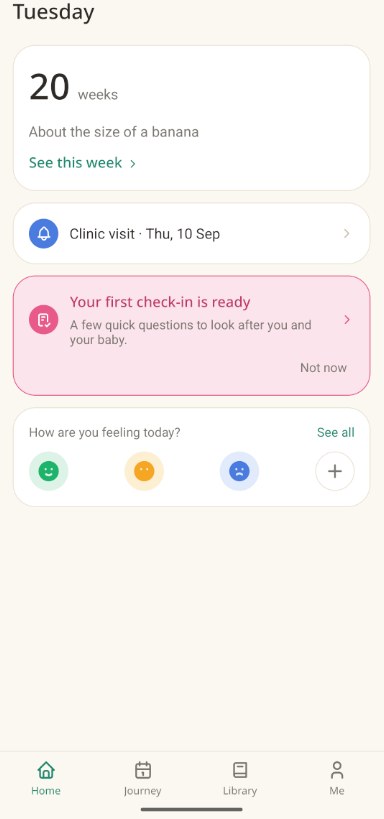
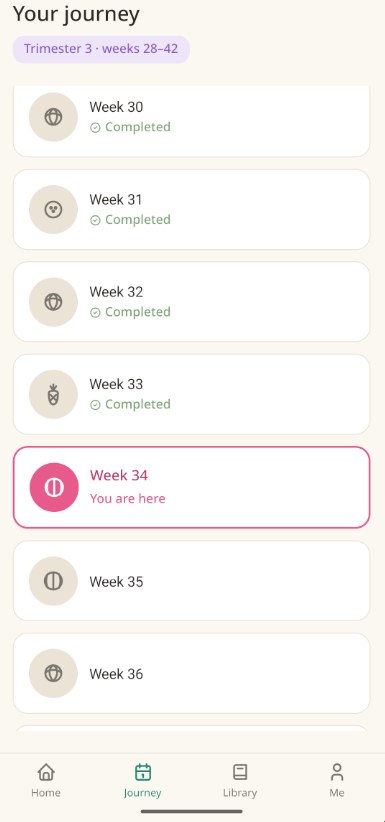
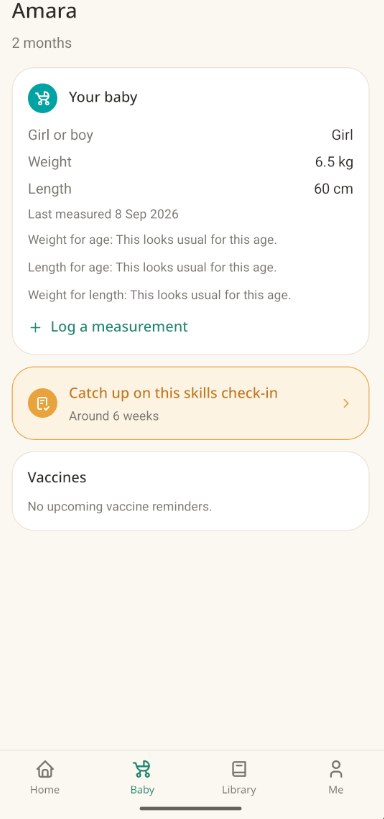
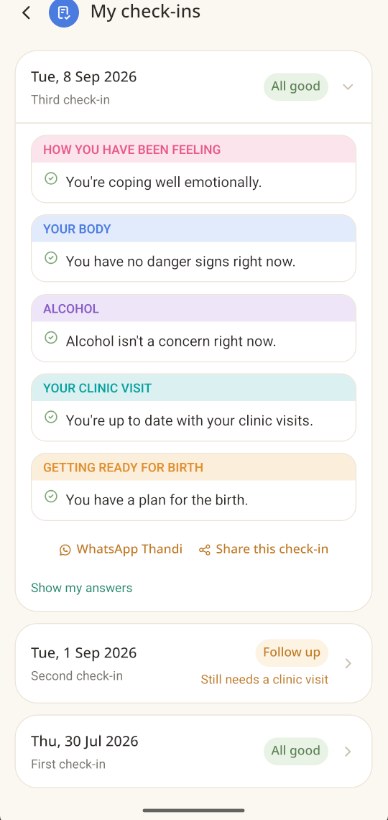
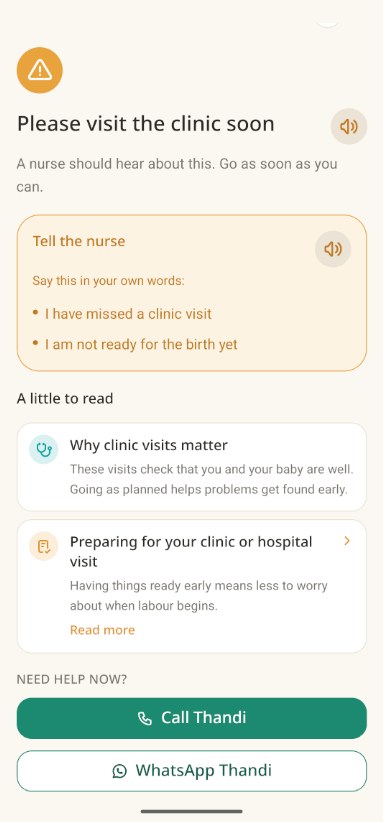
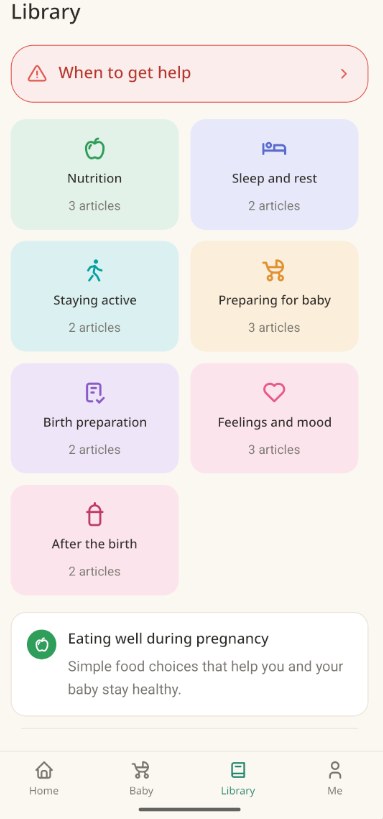
English shown here — the interface and content follow whichever of the four languages is selected.
Every design choice answers a documented barrier.
Mamawise's specific design choices aren't guesses — each responds directly to a barrier the mHealth research literature identifies.
The same research base shows what's achievable: SMS-based antenatal programs alone have been associated with a 174% increase in focused ANC visits and an 82% increase in skilled birth attendance; broader mHealth support has been linked to a fall in perinatal mortality from 36 to 19 per 1,000 births. Mamawise's premise is that a two-way, offline, icon-led tool can go further — while remaining usable in the same settings those programs were built for. Byrne et al., JMIR 2024 ↗
A complete, working product — not yet a validated one.
Mamawise is at the pre-launch stage, and we think that distinction is worth being direct about.
Built & working today
- Feature-complete Android build covering pregnancy, birth, and birth-to-two-years child tracking: onboarding (with a path for mothers whose baby has already arrived), danger signs, library, symptom/mood log, reminders, self check-ins with clinic talking points, check-in share (PDF / WhatsApp), local data export, birth prep, birth recording, postpartum guidance, child growth & milestone tracking with immunisation reminders, and discreet mode (the home screen can show Planner).
- Fully offline data layer with a real, tested schema-migration path. An optional PIN is stored as a hash in the phone's secure storage — never as the PIN itself.
- English, French, Swahili, and Zulu content, complete and WHO-aligned, across every content area.
- Privacy policy and terms live at mamawise.care. Automated tests cover check-in scoring across the pregnancy, postpartum, and child templates, danger-sign matching, date calculations, PIN hashing, and the opt-in impact-metrics payload.
- Optional, anonymous impact reporting: opted-in installs sync aggregated, anonymised usage counts (no personal data, no check-in content) to a live backend — verified end-to-end on a real device.
- Publicly available on Google Play as of September 2026 — get it here. No longer limited to internal testers.
Not yet started
- No pilot, no CHW or clinic deployment, and no real-world outcome data yet.
- No cloud backup, no user accounts, and no tracking more than one child (or a child alongside a new pregnancy) at a time — each planned for a later phase.
- Independent clinician review of the English content, and an iOS build — neither started yet.
- Marketing, distribution, and awareness-building haven't begun — this is exactly where a partner comes in.
We're looking for the partners who can take this from built to validated.
Funding and in-kind partnership would go toward clinical & linguistic review, a store launch, a first real-world pilot, and reaching the women this was built for — rather than a fixed dollar figure, we'd rather scope the ask together.
Pilot sites
A CHW program, clinic network, or maternal-health NGO willing to put the app in front of real users.
Clinical & language review
In-country capacity to bring the five in-progress locales to release quality.
Distribution
Relationships that reach low-connectivity, low-literacy communities directly.
Funding
To carry the project from a complete product to a validated, deployed one.